

How Cellular Repeater Solutions Operate?
Cellular repeater solutions enhance cell signal transmission within buildings that might otherwise experience poor coverage for mobile phones and other wireless devices. These systems can be tailored to facilities of any size, supporting as few or as many carriers as the building owner requires, while also ensuring public safety radio frequencies reach every corner of the property. Let’s explore how cellular repeater solutions function.
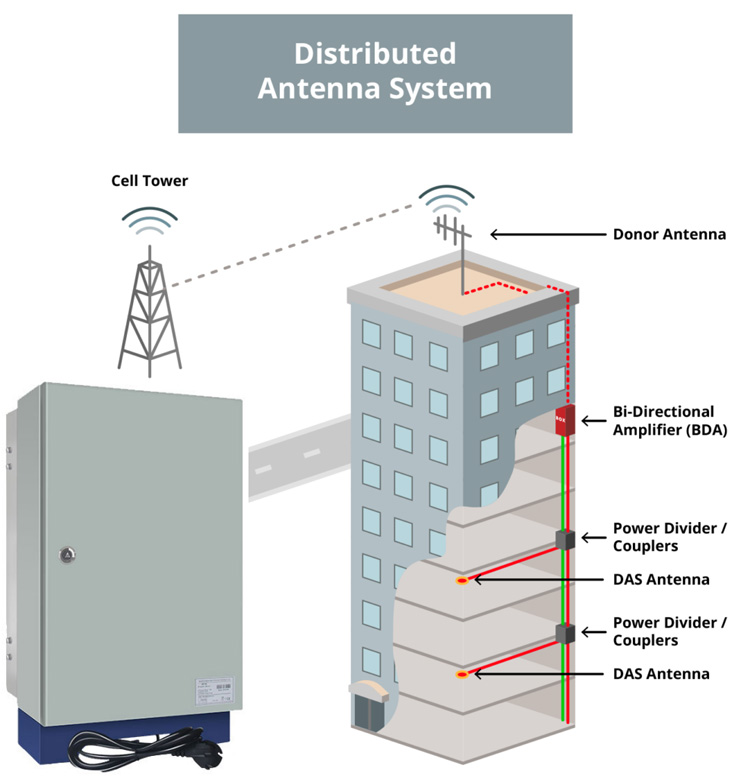
How it works (Step-by-Step):
- Signal Capture (Donor Antenna): A high-gain outdoor antenna, installed on the roof or highest point of the building, captures the weak cellular signal from nearby carrier towers.
- Signal Transport: The captured signal is transmitted via a low-loss coaxial cable from the outdoor antenna to the repeater unit inside the building.
- Amplification (Repeater Unit): The Kingtone amplifier (repeater) significantly boosts the signal strength upon receiving it.
- Signal Distribution (Indoor Antennas): The amplified signal is distributed through cables to one or more indoor antennas, strategically positioned to cover key areas such as offices, floors, or warehouses.
- Two-Way Communication: The system also amplifies signals from mobile devices and sends them back to the cell tower, ensuring seamless calls and data usage.
ds amplified signals from mobile devices back to the cell tower in the opposite direction, ensuring you can make calls and use data.
Donor Antenna:
The donor antenna, also known as the outdoor antenna, is the first component of a cellular repeater system. Typically installed on the roof or the side of a building, it requires a clear line-of-sight to the nearest radio tower. The remote location where the signal originates is also referred to as the “donor.” This antenna serves as a two-way interface: the “downlink” refers to the RF (radio frequency) signal entering the structure, while the “uplink” pertains to the RF signal transmitted back out.
BDA (Bi-Directional RF Amplifier)
A BDA is a highly specialized RF amplifier designed to selectively amplify specific frequencies in both the downlink and uplink paths, thereby enhancing RF signal strength in both directions. Kingtone refers to these amplifiers as “signal boosters,” and their operation is governed by strict federal regulations that system designers must adhere to. RF engineers configure cellular repeater solutions to ensure proper functionality and compliance with these regulations.
RF Distribution Network
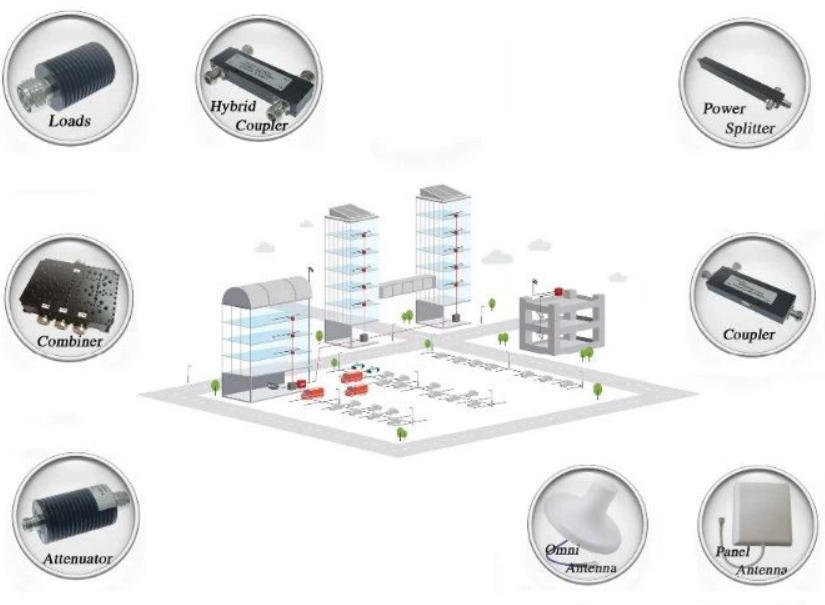
The RF Distribution Network is a hardware system designed to distribute radio frequencies efficiently. The most common approach involves the use of coaxial cables. Standard coaxial cables transmit RF signals to multiple indoor antennas positioned in areas requiring radio operation. In cellular repeater solutions, specialized devices extract a portion of the RF signal from the main coaxial cable to supply multiple antennas. These devices, commonly referred to as “taps,” “splitters,” or “decouplers,” all perform the same essential function.
Indoor antennas can be installed at the end of a coaxial cable or integrated into the cable to support multiple antennas along its route, a setup known as a Distributed Antenna System (DAS). Ideally, indoor antennas should be positioned to ensure clear line-of-sight from all intended communication points. While RF signals can penetrate 2″-4″ wood or drywall walls, their strength diminishes. In parking garages, low-profile antennas (approximately 2″ thick and 6″ in diameter) are often affixed to the underside of overhead structural beams using construction adhesive.
Post time: Jan-22-2026